
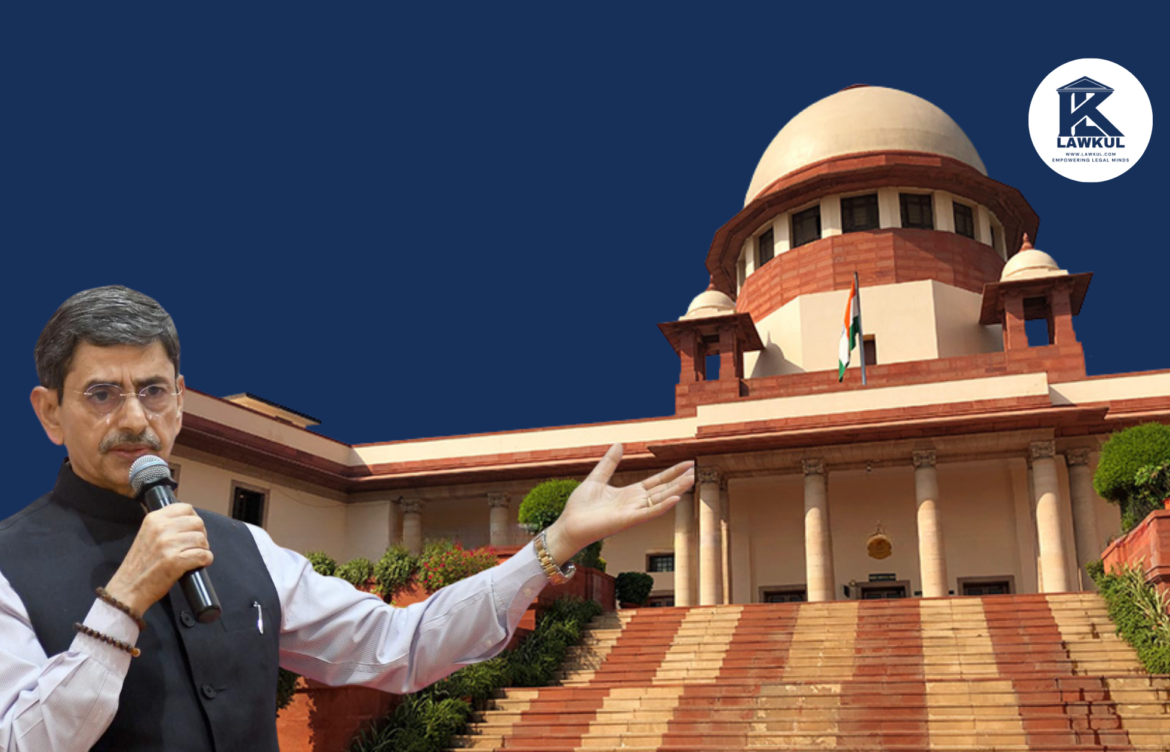
“Cannot Hold Back Bills”: Supreme Court Delivers Major Setback to Tamil Nadu Governor
In a significant blow to the Tamil Nadu Governor, the Supreme Court has firmly stated that the Governor cannot indefinitely withhold assent to bills passed by the state legislature. The apex court’s observations, made during a recent hearing, underscore the constitutional obligation of the Governor to act on bills within a reasonable timeframe and reinforce the principle of legislative supremacy.
The case before the Supreme Court arose from concerns about several bills passed by the Tamil Nadu Legislative Assembly that were awaiting the Governor’s assent for an extended period. The state government had approached the court seeking a directive to the Governor to act on these pending bills. A bench comprising Chief Justice of India (CJI) D.Y. Chandrachud and Justices P.S. Narasimha and J.B. Pardiwala expressed strong disapproval of the Governor’s inaction.
Justice Pardiwala affirmed that the Court’s earlier decision in State of Punjab v Principal Secretary to the Governor of Punjab (2023) laid down the correct position. That judgement, authored by former Chief Justice D.Y. Chandrachud, with Justice Pardiwala also on the bench, held that Governors cannot “thwart the normal course of lawmaking by State Legislatures.” The Court strongly rejected the notion that an unelected Governor could wield an effective veto over democratically elected legislatures. The bench in today’s decision also reiterated that the constitutional scheme does not make place for the idea of an “absolute veto” or a “pocket veto”.
Key observations and direct quotes from the Supreme Court:
• On the Governor’s Duty: The Chief Justice stated, “The Governor has to act as soon as possible. What does ‘as soon as possible’ mean? In today’s world, ‘as soon as possible’ means now.” This emphasizes the urgency required in the Governor’s actions.
• On Withholding Assent: The court firmly rejected the notion that the Governor could indefinitely delay acting on bills. Justice Narasimha remarked, “The Governor cannot say ‘I will sit on it indefinitely’.” This highlights the constitutional impropriety of such inaction.
• On the Power of the Legislature: The Supreme Court reiterated the importance of respecting the legislative mandate. CJI Chandrachud observed, “The legislature has spoken. The Governor cannot say ‘I disagree with the legislature, therefore I will sit on it’.” This reaffirms the supremacy of the elected legislature in the law-making process.
• On the Meaning of ‘Reconsider’: The court clarified the scope of the Governor’s power to return a bill for reconsideration. Justice Pardiwala noted, “The power to send it back for reconsideration cannot be used to thwart the legislative process.” This limits the Governor’s ability to repeatedly return bills and obstruct the legislative will.
• On the Timeframe for Action: While not explicitly setting a rigid deadline, the court strongly implied that the Governor must act expeditiously. CJI Chandrachud emphasized, “The proviso to Article 200 cannot be used to defeat the will of the legislature. If the Governor withholds assent, the consequences are serious.”
The Supreme Court’s forceful pronouncements constitute a significant setback for the Tamil Nadu Governor and a reaffirmation of the constitutional principles governing the relationship between the Governor and the elected government. The court’s observations make it clear that the Governor is not a parallel legislative authority and cannot frustrate the democratic process by unduly delaying or withholding assent to bills.
The Supreme Court’s intervention is expected to expedite the process of granting assent to the pending bills in Tamil Nadu. The ruling reinforces the importance of timely action by Governors in upholding the democratic mandate and ensuring the smooth functioning of the legislative process.